
One month has passed since the fire took our infrastructure, equipment and inventory.
Days, disappearing into weeks, within seasons. Last week we felt some of the first signs of Autumn, with cool mornings and dew. The farm crew mentioned the change in the signs, and as if on cue the first Canadian Geese of the season whished overhead, only five, their oily wings cutting through the air, with a sound like brooms swept on wet concrete, shwoot, shwoot, shwoot. No honks from this crew as they sweep into the distance.
This week however, the humidity dropped and temps have risen again into triple digits. Wildfires popping up throughout the region, the haze of smoke on the horizon, and the breeze has taken its summer form once again, the blow dryer, blowing dry in the mornings and hotter and dryer as the day turns long, trying to blow the tarps from the harvest trailer and keeping the crew on their toes.
That is what farmers know: doing. A farmer’s job is an endless to-do list that never seems to fall further behind but only expands, into more hours in the day, and more days in the week. And when you are feeling upset, nothing feels as good as burying yourself into doing and getting things done, even if it’s doing things you’ve already done before, and sometimes especially so. That is the farmer’s reality: doing is your job. Checking off boxes on one list after another after another, and learning to be fine with never finishing it. And well, that is life too, I guess.
It was in the days after the fire, as the ashes were still smoldering, that we didn’t know what to do, because everywhere we turned our to-do list couldn’t be done, because we didn’t have the tools, the space, the infrastructure to get it done. So our first task was to get back to doing, and with your help, we did. Getting the crew back in the field hoeing with new hoes, and harvesting with new buckets into newly built dryers in the first few days, and then within the first week, we were back online with enough drying to start back to the full harvest schedule, and that has felt wonderful.
Because as everyone knows, the best thing to do when you feel bad is to get out there and do something! So, do things we did, to the total of more than 12,000 lbs of freshly dried herbs already back in storage since we started back, and three dryers full as we write this, with two more to be filled tomorrow.
And we are moving forward. We were able to make major progress on cleaning up this week. Looking at what was left after the fire has been emotionally taxing. Piles of twisted metal and ash. It took four days to haul off the metal to recycling, loading 54′ dumpster bins to the brim of capacity, watching as one truck load after another lumbering off lurching awkwardly under the hulk of steel. The pile of our rubble slowly dwindled to a handful of piles of ash, two gunny sacks full of nails and screws, and a half a dozen charred posts varying between 2-4′ in length, nails extruding from their sides like some sort of medieval weaponry. The benefit of building with only locally milled wood, many sourced from downed trees on the farm, and metal was that when it burnt as hot as it did, it left only a small pile of charcoal after we cleared all the metal. Surprisingly little, considering how much it held.
And that is where I found myself this morning, once again facing that endless list of things needing done, looking at the expansiveness that came from the nothing that remains, just burnt slabs and cracking cinder block, small piles of molten conduit where electrical lines once ran, thinking how much more there still is to do, when it was already a season that held so much doing.
These are the moments that grief sets in, and the worry and work and pain of it all well up in my eyes, feeling like the list is just too long for one group of people at the moment. But the tractor turning over reminds me the crew is waiting for me for the Tulsi harvest, its bubble gum scent already seemingly catching my mind, and then the acrid, nauseatingly pungent Wormwood harvest to do after that.
Our mechanic gives me the thumbs up as he pokes his head out from underneath Snip, our trusty 1968 harvester, a grease gun in his hand. Each of us on the team having our own moments of strength and struggle. And farmers understand struggle, because it comes with the job, but mostly we do it in private, in the field, out of the public eye. Farming can be lonely, and hard, and often times our struggle goes unnoticed, unrecognized, and again I have to think that is like life too.
As I climb onto Snip, I wipe the tears from beneath my sunglasses with my sleeve, putting my ear protection on in one drawn out motion. Flipping the switch and hitting the button she comes to life, ready to face another harvest. As Snip and I make our way to the far field, I pass by a happy sight… Elana, our old farm manager, and Kendra, a former employee and friend as well, are in the field, kids in tow.
The night of the fire I woke up with a start in the middle of the night remembering all the seed was in the storage barn. More than a decade of seed saving, breeding, on top of decades more before me. Genetics passed down from our mentors and elders, those that walked before us on this path of growing botanicals. The reality of the loss kept me up in bed, worried about what that meant for the future of the farm. Because what is a farm without seed?
Elana and Kendra answered the call, and the Monday after the fire we stood around the corner of the storage barn where the seed had been stored. Elana herself first started as the person responsible for seed to seed, ensuring that all of our greenhouse work is on time and seeding is happening as it should, and then wrapping around and saving our seed for the years to come. As we stood around the ashes, we noticed that thousands and thousands of baby plants were sprouting in the corner, where we had stored the seed. Having gone through the fire, and watered from the fire suppression, and exposed to a week of Applegate sunshine, the seeds were germinating!
These seed fairies and their darling children have been coming every week, buckets and wagons in tow, working with myself and the farm team to time all the seed that is ripe. We are forever lucky that the fire happened when it did in the season, when the plants were full and lush in the fields, and we could seek and select the seed we want, list of needs in hand, knowing how important it is this year more than any other in recent past.
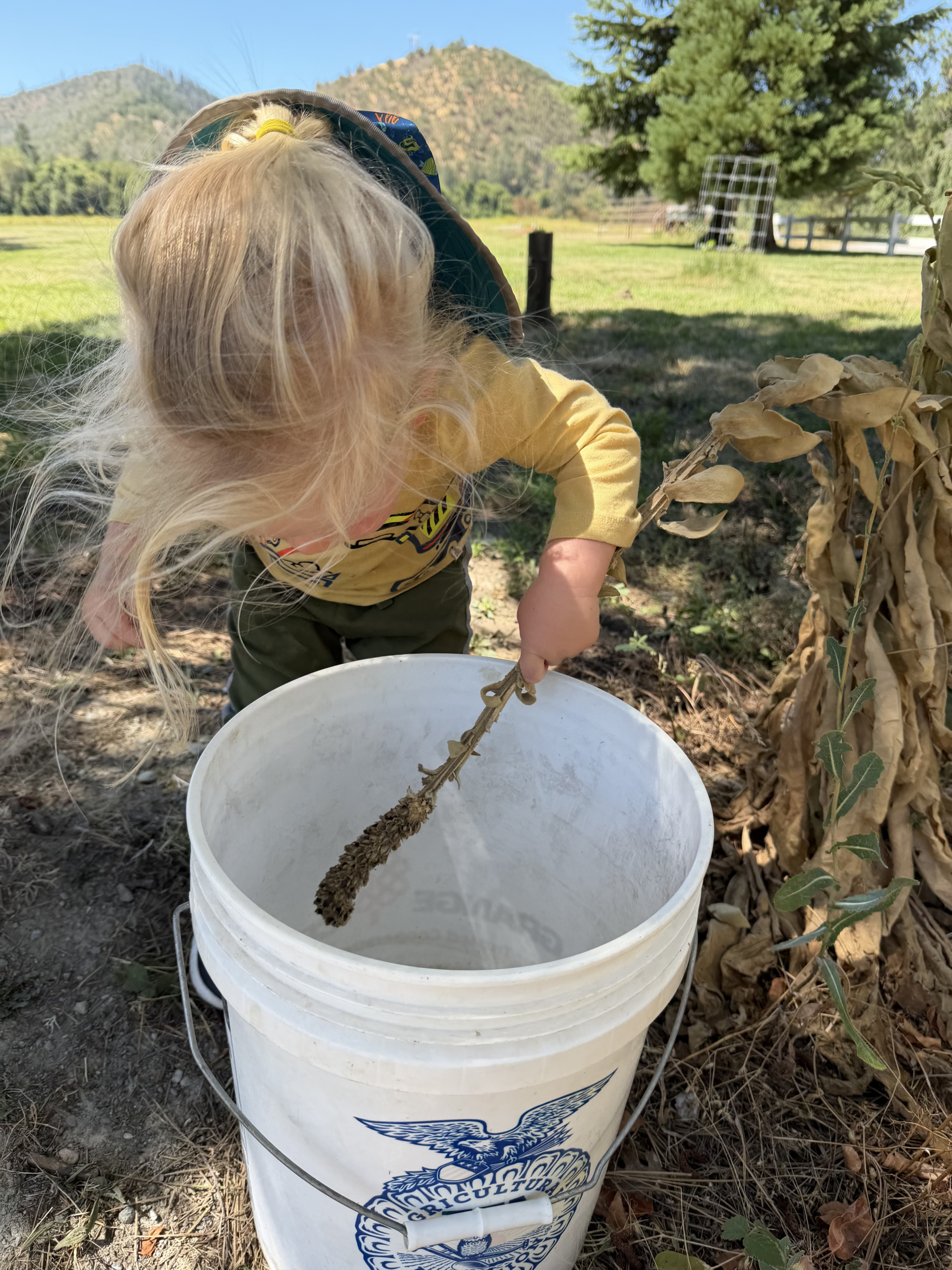
As I pass by I wave, watching as at 2 years old our youngest seed saver is using his whole heart and spirit to shake the large mullein stalk into the bucket like his mother, whether intentionally or not seemingly both saving seed and planting seeds within himself in one action, unknowingly sowing the seeds of a future herbalist or maybe even a future herb farmer deep within. My thoughts drift to just how powerful that seed will be, and just how strong that medicine. And that is the magic of this whole month.
As we passed the three week mark, our GoFundMe passed $300,000. More than 3,000 people have contributed in some way, all of it meaningful, all of it impactful. From contributions as low as a dollar to those of thousands of dollars, and those contributions that cannot be counted in terms of figures, neighbors arriving to fight the fire side by side with us, and all of you who have shown up in so many beautiful and unique ways since. The sheer beauty of what happened this last month, amongst so much pain and struggle, will sit with us for a lifetime.
Oftentimes herb seed is difficult to germinate. It requires stratification, tricking the seed into thinking it has survived a winter by putting it in the fridge, for instance. Herb seeds are also notorious for being intermittent germinators, meaning even when planted in perfect conditions, not all seeds will sprout at the same time, but rather germinate sporadically over weeks, months, and sometimes even years. Some seed has become codependent on fire, needing to be stratified by the heat of wildfire to trigger its emergence, the first plants on a newly burned landscape.
Each and every one of you have planted a seed into Oshala Farm and its recovery. We are starting to see some of those seeds germinate. However, we know that many may lie dormant for years, waiting for the right conditions to finally break free from the soil.
Elise and I took a weekend to ourselves finally, knowing that to do great things takes time to envision them first. Time for the two of us to brainstorm, bounce ideas, share worries, cry together, and more than anything dream of what is possible. Oshala Farm is bigger than Elise and Jeff because we dared to dream bigger than ourselves. That meant we needed to become more than who we were, we needed to learn things we didn’t know, we needed to do things we weren’t sure we could do. And most importantly, we needed to include other people within our dream. Because a dream bigger than ourselves means we can’t possibly do it by ourselves. This time around we also realize that dreaming of a bigger and better Oshala might mean dreaming beyond Jeff and Elise, to the next generation of herb farmers as well. How do we ensure their needs are met as we look to rebuild and rebirth the next phase of Oshala? This type of work takes time and space and vision, which is oftentimes so hard to do as we are chasing the endless to-do’s.
As Snip and I pass the seed harvesters I can’t help but think this work is really for them. The children, the seeds, the plants. As a farmer my job is to care for the next generation of the plants I grow, of the lives I tend, of the people who will inherit this planet. Turning into the far field I see the crew waiting for me, pulling the last of the aluminum irrigation pipes from the field as I pull up. The team falls in behind preparing the tarps for the harvest, and with a nod from the team the first smell of tulsi cuts through the air.
Jeff, Elise, and the Oshala Farm Team
How You Can Continue to Stand With Oshala
Many of you have reached out asking how you can continue to help, and we’re so grateful.
If you’d like to support our rebuilding efforts financially, you can contribute to our fundraiser, which is helping us replace essential infrastructure, equipment, and keep our incredible team working as we rebuild.
→ Donate to Help Rebuild Oshala Farm
If you’d like to offer equipment, materials, volunteer time, professional services, or another form of support, we’ve also created an Offer Support to Oshala Farm form where you can let us know how you’d like to help.
→ Offer Support to Oshala Farm
And if donating isn’t possible, sharing our story with your friends, family, and community continues to make an enormous difference.