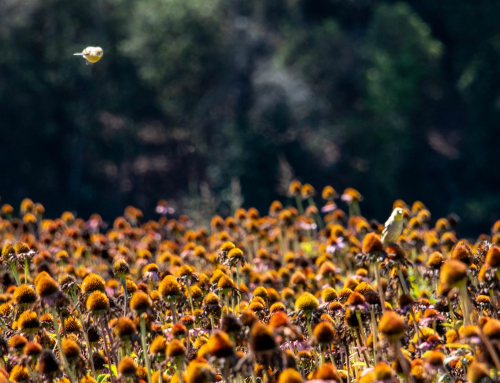

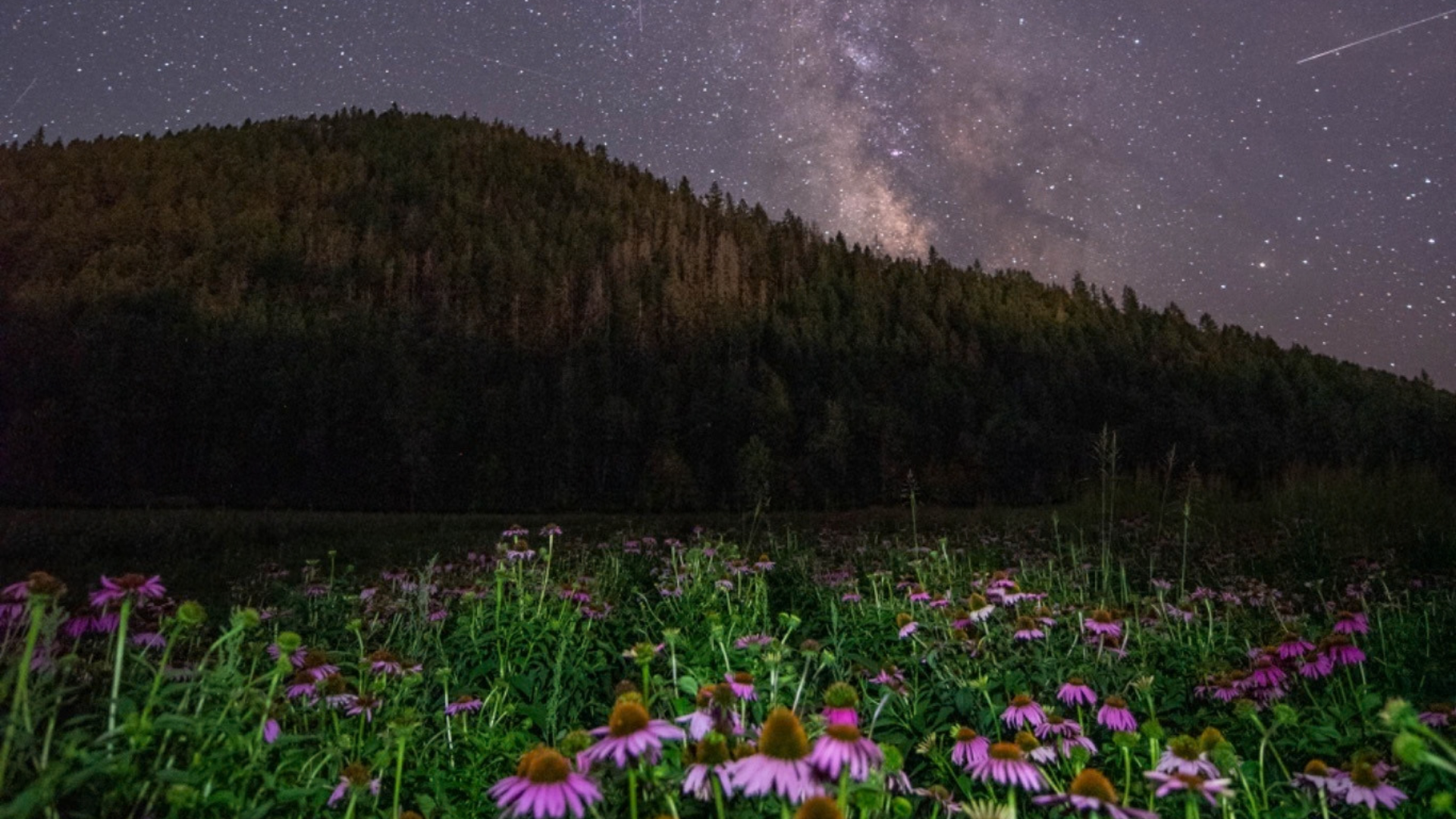
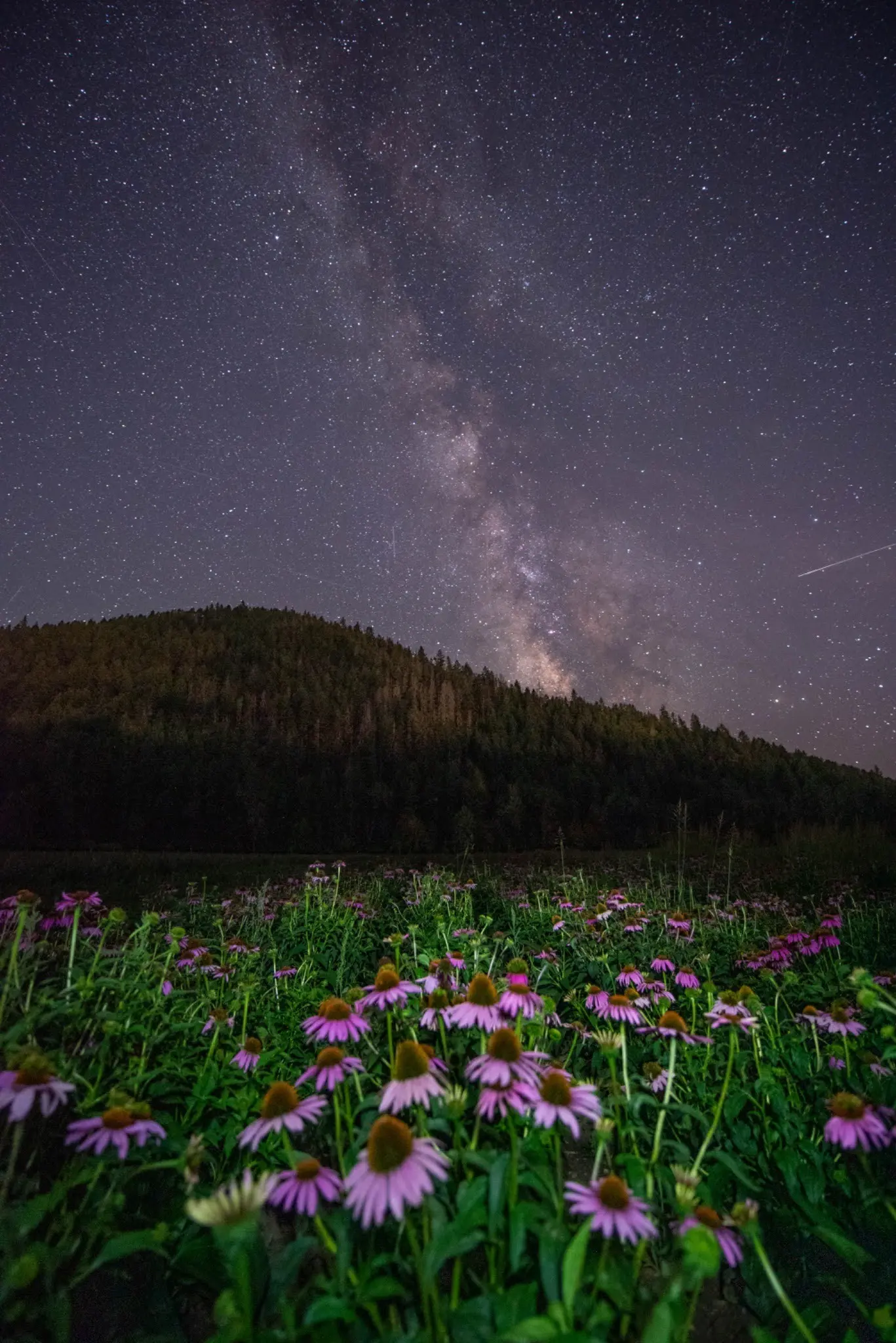
Juni pulls against the leash as soon as the door is open, yanking me out of the house one last time before bed. As I stumble down the stairs behind her I’m startled by the clear sky. The clearest night in weeks, and no moon. As the glow of day fades on the horizon, the stars are already bright against the purple behind them. I’ve been wanting to capture the echinacea at night all summer, imagining it in full bloom beneath the Milky Way. But since the fire, I haven’t picked up my camera, whether from lack of time or the crushing of my spirit.
Recognizing my chance, I know the field of first-year echinacea is in full flower, while the second-year field has already crossed over to seed. The flower heads have long dropped their petals, leaving only spiky balls of dry seed, the plants now storing their energy in their roots. This is my last opportunity this year to capture it, and the conditions are lining up perfectly. I step inside and collect my camera gear. Quietly, almost whispering, I tell Elise my plan — as if not to allow the stars or flowers to hear.
In the middle of the echinacea field, the flowers gently swaying around my waist, I work in silence. I set up the tripod between two rows, working through the ISO, f-stop, and finally shutter speed, focusing on the specifics of the task. The silence is overwhelmingly loud — crickets and frogs in a chorus of song that’s hard to discern one from the other, a wall of silence.
Only the sound of my camera pierces the night. The shutter opening to the sky is startlingly loud in moments like these. The first shots come in — small adjustments to the focus, the framing, the light on the echinacea and how it hits the lens, the stars peering out of the darkness overhead.
Suddenly, almost against my will, my arms shoot overhead, as if my body reacted without my mind. Wind hits my hair as a white ghost seems to fly within inches of my head. A giant white flash rushes from behind me, disappearing into the blackness of the night above me.
Again, out of the darkness the white emerges mere feet from my head, its wings outstretched, pure white — my brain tells me it is a giant white heron. It pulls up just short of my head, bolting silently into the sky. As it turns, wings stretched wide through the stars, I see it clearly for the first time — it is an owl. As it crests the hill, its wings dislodge the stars, sending them like Van Gogh’s Starry Night cascading off the tips of its wings with each silent beat. Not a sound as it disappears again into the darkness of night beyond the Milky Way.
I go down into the flowers on instinct, camera forgotten, heart going. When I look up there’s nothing. Just stars.
It comes again before I’ve caught my breath. And again. I’m moving now, weaving through the echinacea toward the truck with my arms locked over my head, and every few steps the air moves again, that same silent drop out of the dark, close enough to feel, never once touching skin. The echinacea flowers whip against me as I retreat across the field.
My eyes have now fully adjusted from the camera to the darkness as I track my attacker while I retreat. It continues to dive upon my head, only at the last second shooting back into the stars with a mere change of its wings. It works me in figure eights from above, slicing infinity symbols in the sky.
I hesitate to shine the light on it. Somehow even in this moment it seems a deep betrayal to this messenger of the night. But after the eleventh pass, mid-turn, about to come at me again, I finally pull the headlamp from my pocket. Light punctures the blackness in a tight shaft, striking the bird square in the chest. I feel its disgust through the night air. The light, however, works like magic. The owl disappears just as quickly as it had appeared, leaving nothing but darkness, the vast expanse of the field around me, and the stars overhead. The silence has never been broken except within my own head.
My mind is racing for some understanding of what just happened. My blond hair — Elise says now gray!! — must have looked like a scrumptious white rabbit in the night. But the owl never made contact. Its trident of talons extended toward my head as it approached at full speed, every time, and every time it pulled up short. As I return to my camera, I keep looking over my shoulder. Whatever sense of safety I had, now shattered.
Certainly, if it had wanted my head, it would have taken it in the first pass, sinking its claws into my skull. From the darkness it came and into the darkness it disappeared again. Looking into the distance from where it came, the silhouettes of the white oaks seemed to glimmer silver in the blackness along the edge of the field, Grandmother White Oaks. Walking briskly back to the camera, I see Grandfather Black Oaks in the distance surrounding the house. I take one last shot as I gather my gear, the clicks of the shutter cutting through the night. I pull the hood of my black sweatshirt up over my head, picking my way through the waist-high flowers toward my truck on the field road. No — this felt more like a warning from the elders that watch over this place.
A couple days later, Juniper and I find ourselves walking the field roads right alongside the echinacea. As my mind wanders back to the experience a few nights before, Juni roots around along the edge of the field road where it disappears into wild space and then forest. She is a tireless gopher chaser, her body lost in the brambles, only the swaying weeds giving away her location. I whistle for Juni as I turn back towards the house but she is slow to follow. I find myself trying to understand what happened that night, but maybe I’m attaching meaning where I shouldn’t. I don’t know if the owl was the guard or just the messenger. What I know is that it didn’t want me there, and it made sure I was aware of it without ever laying a talon on me. Juniper finally lumbers out of the understory dragging a fresh deer leg, her tail wagging heroically, nearly throwing her off course.
Two weeks have passed since that night in the field. Juni and I walk outside before bed. The full moon has just risen over the hills, shooting long rays of white light from the bottom of its circle, beaming towards my chest. Juniper pulls on the leash but I pull back, watching and wondering if it means some change in the weather is coming. Fall is here, the equinox having already passed a few days ago, but the signs are clear. The dew on the plants hangs long in the morning, the pants of the crew wet from the knee down as we work through the fields. The black walnut has turned from green to yellow, and sister oak, the shapeshifter, has changed its leaves of three from green to crimson red, and now they are just barren sticks in the underbrush beneath the oaks along the field edges.
In the distance, a great horned owl is vocalizing to others, its guttural bark unlike any other bird or owl even — not a hoot but a cry, the female calling into the night: “aaahhn, aahhn,” almost like a fox. Suddenly, from above us, another giant horned owl — the one that hangs out in the dead spruce outside the back window every night — drops down, swooping low directly over Juni and me, floating silently on gliding wings, landing in the pear tree on the other side of the yard, heavily weighed down with ripe fruit. The only sound is two pears falling in light thuds on the ground below.
As I lie in bed the owl begins its call outside our open bedroom window, and it makes me realize it is there most every night while we sleep.
The roots are ready for harvest. Tomorrow we start digging.
How You Can Continue to Stand With Oshala After the Fire
The outpouring of support we’ve received since the fire has helped us get back into the fields, keep our crew working, and begin rebuilding what was lost. We are incredibly grateful.
One of the best ways you can continue to support Oshala Farm is also the simplest: buy herbs from us.
Our harvests are well underway, we’ve stacked up tens of thousands of pounds of freshly harvested herbs in storage, and we’ve brought in beautiful herbs from our Oshala Collaborative Farmers. Many of your favorite herbs are back in stock, with more returning every day as harvest continues.
If you’d like to support our rebuilding efforts financially, our fundraiser is still helping us replace essential infrastructure and equipment as we continue the long process of rebuilding.
→ Donate to Help Rebuild Oshala Farm
If you’d like to offer equipment, materials, volunteer time, professional services, or another form of support, we’ve also created an Offer Support to Oshala Farm form where you can let us know how you’d like to help.
→ Offer Support to Oshala Farm
And as always, sharing Oshala Farm with your friends, family, herbalists, practitioners, and community makes an enormous difference.