
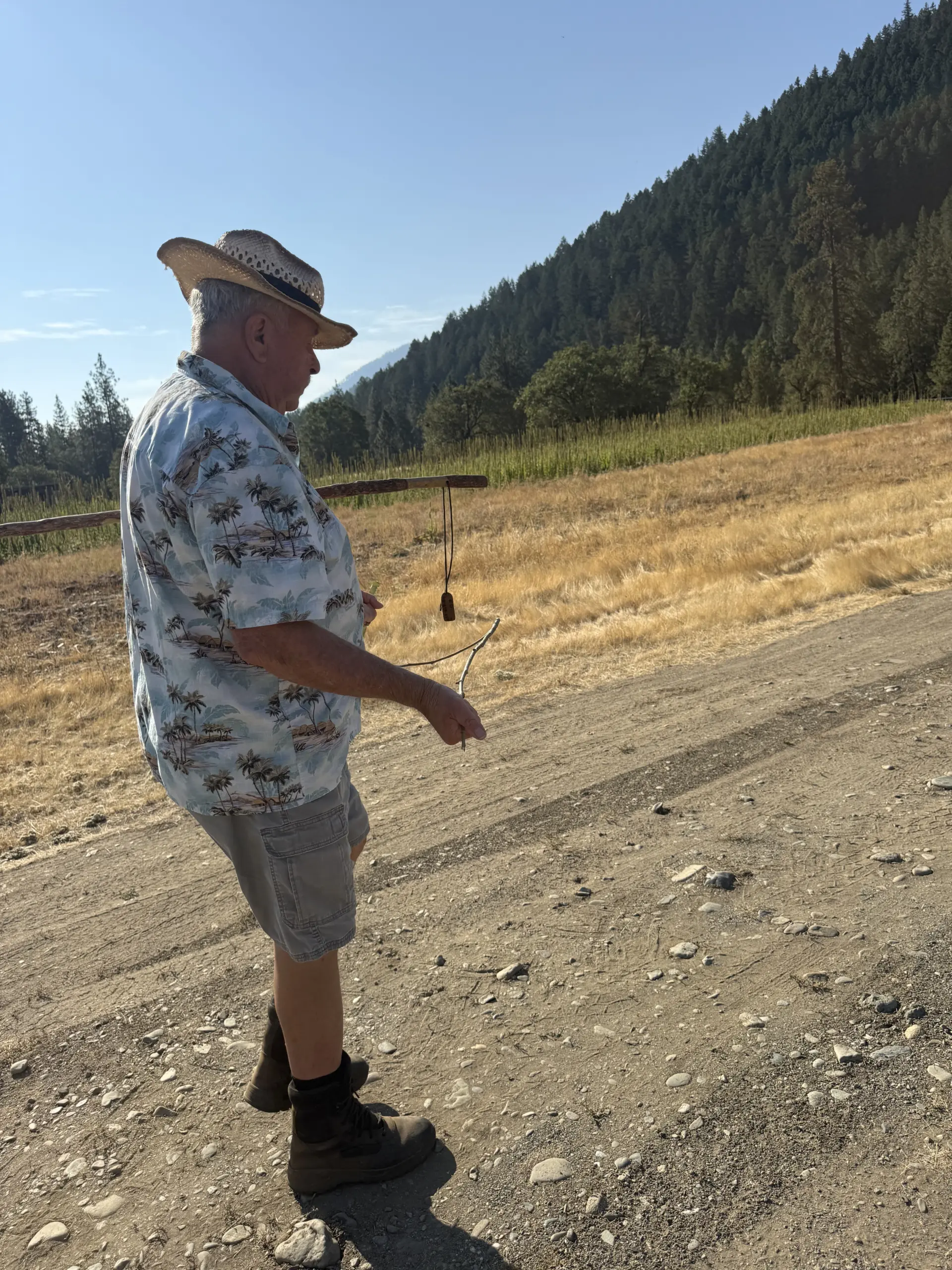
He drew a satchel from the backseat of the vehicle, a well worn backpack, a bouquet of leaves billowing from its unzipped top. He rummaged through the leaves pulling out a forked stick of green cottonwood. At 83, Ed Owneby is now a full-time caretaker of his wife, though today he was able to get his daughter to help so he could come do what he has done for more than 50 years. His eyes fixed on the horizon as I began to explain my hopes for the day, to find water.
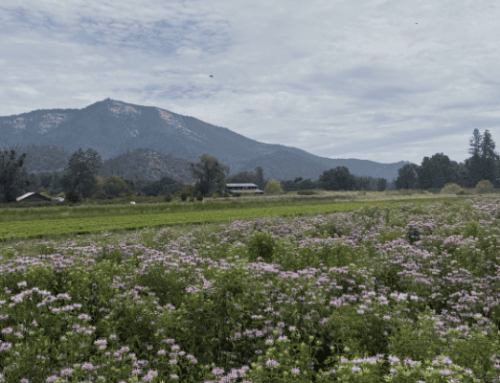
I explained how the fire had wiped out our barns, how our root washing equipment had been damaged, and how the power infrastructure had been destroyed to power our wash line. The conveyors, barrels, tanks, and sprayers lined out before him now, having been moved to this new location. Power will come in from here and go to there, I said, the dryers will be here…. I’m hoping to place the wash line over here…. but we need water.
At 83 years old, Ed is one, if not the last, traditional well dowser in Southern Oregon. As I talked and pointed he drank in the property, his eyes glassy, like my grandfather’s had been. Moist with age and cataracts, tired from a life of watching.
“The water travels in channels at 45 degrees to the river, flowing back not just to the Applegate River but to the Rogue. Do you see the trees there along the property line, notice the blue hint in the leaves of that large white oak and the two firs and the tall ponderosa there in line with it? Now follow that line back towards the river, look how it corresponds with large oaks, fir and ponderosa leading all the way to the river, notice how much bluer they are compared to the ponderosas just to their right?” Yes, I had noticed, which is why I parked where I did. I thought the water was up near those trees, but it is a bit far from the wash line, but Ed was showing me the pathway of the water, the veins of water moving through the earth.
What Ed does has been called different things depending on who’s telling it and when. In parts of the rural South and Appalachia, it’s water witching — a name that leans into the uncanny, the sense that some people are simply born with a sensitivity the rest of us don’t have. Miners in 16th-century Germany called it divining, working divining rods to find veins of ore the same way Ed reads veins of water, a practice old enough to be written about, skeptically, in mining texts nearly five hundred years ago. The word we use now, dowsing, is the newer one — plainer, more technical-sounding, the word that survived into dictionaries and scientific studies while the others faded into folklore. But the names change more than the practice does. Long before soil reports and drill logs, someone in every generation has walked a property with a forked branch, reading water the way Ed reads it — in the blue cast of a leaf, in the twitch of a green stick — and calling it whatever their place and time called it.
He claimed he needed his walking stick, his footing unsure at this point, though it never touched the ground, rather firmly tucked under his arm.
Last night, after his wife had fallen asleep, Ed had slipped out of the house with the same walking stick and a pair of shears. Under cover of darkness he worked his way down towards the creek behind his house on the edge of town. As the dry grass turned moist along the stream bank, the rubber tip on the end of his gnarled walking stick began to leave small triple-ringed marks where he leaned on it heavily, as the grade changed abruptly on the edge of the creek where the cottonwoods had grown both large and dense. The moon was reaching its halfway point, lighting his work. He selected his branches amongst the smaller saplings in the understory, working out the leaders to where they jutted with new growth and cutting them below the fork and tucking them stem side down into his bag. When he had collected enough, he made his way up the muddy bank, leaving his three-legged tracks next to the does who had been there drinking a few hours before.
Taking the main lead in his right hand palm up, he twisted the side branch as he rotated his left hand up towards the sky as well, thumbs out, the pressure causing the forked branch to stick straight out at attention.
The stick does different things for different people, he explains. “For me, when the water is moving with good flow the stick starts to bounce. The more it bounces the more water.” Slowly he works his way towards the hidden watercourse he had visualized from his reading of the trees, working perpendicular to where he believed the water would be. The stick was twitching as he walked, like the tip of a fishing rod that is being struck by the fish testing the bait below, small little bites, but like a seasoned angler Ed knew it wasn’t yet time to set the hook.
As we approached where we had thought we would find water, the stick went still, not a movement. Ed was surprised, we kept on our path, working perpendicular along our anticipated line. Suddenly the stick began hopping madly. “Here is our main lateral,” he explained, turning to follow the vein of water, his stick bouncing as he walked, stopping every few steps to readjust the stick in his hand because the hopping was causing the stick to slide in his firmly gripped hands. Suddenly the stick began moving even more, as he explained that we had just found a cross lateral — where another rivulet of water comes down and crosses with the other. Working his way around the location, he confirmed. For the first time his walking stick came into action, pressing into the rocky dry earth. It was hard to believe this was the spot, but he said, “Right here, under my stick, that’s where you want to dig.”
Ed asked me if I wanted to try…. He placed the sprig in my hand and backed me up from our newly marked X. He showed me how to hold my thumbs, how to twist the branch, bringing the stick alive as if turning it on with a switch. I walked slowly towards the X, the pull was unmistakable, but was very, very slight. It was not bouncing wildly like a fish on the string, but as I walked back and forth again and again I could definitely feel the stick tugging my palms as it twisted imperceptibly towards the earth. Ed explained that only about 5% of people have the ability to do this work, and that statistically more women than men. Alas, maybe I wasn’t sensitive enough. As we stood over the spot that we had marked, Ed grabbed the lead of the stick with his right hand and instructed me to hold the other side with my left, twisting it like he had taught me. The stick didn’t move. “We need to complete the circuit,” he explained. “Hold my hand now with your other hand.” As we held hands it was as if the fish struck and the tip of the rod began bouncing wildly. I let go of his hand, it stopped, and we held hands again and it bounced until it slipped from my grip and I had to pull my hand from Ed’s again to reposition the stick.
Mesmerized, I watched as Ed worked his way around finding another lateral and cross lateral, we marked a second location about 250′ away. He explained the small bites of the bouncing rod as he walked around were probably 3-5 gallon a minute wells, the spots we marked he anticipates 25-60 gallons per minute, probably between 80 and 120′ in depth.
As Ed put his walking stick back into the backseat of his car he asked two things from me: “Make sure you call me and tell me how we did! And, please have a splendid day.”
As I watched him pull away, his tires slipped slightly on the dry rocky ground, with the sound of gravel chafing against rubber. I couldn’t help but think about how this important skill was dying. At 83, Ed has no student, all the others that used to be in the area have passed on. Something that was so important to farmers and land owners for so long has become a forgotten craft. Dowsing…. witching….. divining…. We will see what Monday brings.
Jeff, Elise, and the Oshala Farm Team
How You Can Continue to Stand With Oshala
Many of you have reached out asking how you can continue to help, and we’re so grateful.
If you’d like to support our rebuilding efforts financially, you can contribute to our fundraiser, which is helping us replace essential infrastructure, equipment, and keep our incredible team working as we rebuild.
→ Donate to Help Rebuild Oshala Farm
If you’d like to offer equipment, materials, volunteer time, professional services, or another form of support, we’ve also created an Offer Support to Oshala Farm form where you can let us know how you’d like to help.
→ Offer Support to Oshala Farm
And if donating isn’t possible, sharing our story with your friends, family, and community continues to make an enormous difference.